
main page — COMP 335 Communicating Computer Science
Unit 2: Empirical Science & Statistics
This unit covers:
- basics of the scientific method
- statistical tools for educational research
Learning outcomes
- Be able to competently use the terminology of empirical science, such as theory, hypothesis, experiment, null hypothesis.
- Be able to understand, explain, and evaluate empirical science research in the domain of education research.
- Be able to qualitatively explain the purpose and use of statistical hypothesis tests.
Pre-session task
Watch the Veritasium video below on the Replication Crisis of Science and answer these guiding questions on on Slido:
- What is (in your words) the meaning of the p-value?
- Name a suggestion to counter the “reproducibility crisis” in empirical science.

Material
-
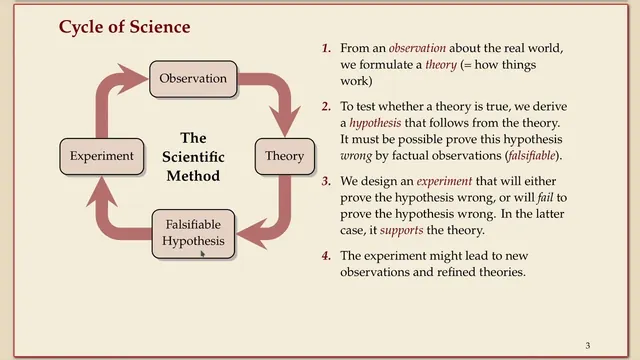
Video · transcript (2022-10-14, 47:17): The Scientific Method, hypothesis testing, pitfalls
Chapters
5:09 Experiment
5:53 Statistics
7:20 What's the Scientific Method
7:42 The Scientific Method
11:48 Motivated Expectancy Value Theory
14:09 Controlled Experiment
16:53 Prove the Hypothesis
17:20 Null Hypothesis
25:56 Example for the Student T-Test
28:31 Gold Standard of Controlled Experiments
31:47 Observational Studies
32:18 Confounding Variable
35:06 Observational Study
36:07 Gold Standard
40:41 False Positives
41:09 Publication Bias
43:24 Statistical Significance
Further resources
- Crash Course Statistics
accessible YouTube series giving some more details and lots of examples of how to use statistical methods